Who should read this article: Administrators
Caller IDs identify the origin of outbound calls made from your contact center. Caller ID groups let you control which number is displayed to contacts and recorded in Call Detail Records (CDR), based on how agents dial and how you configure group rules.
Introduction
To place outbound calls, your contact center needs at least one phone number and at least one Caller ID (CID) that carriers accept as the call origin. CIDs are used for manually dialed and click-to-call calls made through Agent Panel.
Caller IDs for Dialer campaigns are configured separately in the Add/Edit campaign page and follow a different priority.
You can buy numbers from Voiso for any location in the world and use these numbers for both your inbound and outgoing calls. Optionally, you may add third-party numbers for your CIDs and CID groups.
Caller ID groups are applied through two mechanisms.
- Cut prefix CID groups are selected by agents in Agent Panel. Agents dial a short prefix before the destination number to force a specific outbound Caller ID. The prefix is removed before the call is dialed, so only the destination number is sent to the carrier and shown in Agent Panel call history and in the CDR.
- Regular CID groups are applied automatically. If the dialed number starts with a configured group prefix, Voiso uses a Caller ID from that group. The prefix is not removed from the dialed number.
Both group types are scoped by teams. Team assignment determines which groups can be applied to a user and which cut-prefix groups are available to select in Agent Panel.
Selecting Default in Agent Panel disables cut-prefix selection and returns the agent to automatic Caller ID selection based on regular CID groups. If an agent is not assigned to a team with a regular CID group, their personal CID (if configured in their user profile) or the default contact center Caller ID is used.
How Caller ID selection works
This section summarizes the selection logic for manual dial and click-to-call calls made through Agent Panel.
CID group types
Cut-prefix CID groups
A Cut prefix CID group is a group where Cut prefix is enabled in the group settings.
- Agents can select only cut-prefix groups in Agent Panel.
- Agents can also dial the cut-prefix manually before the destination number.
- When the cut-prefix is used, it is removed before the call is dialed. Only the destination number is sent to the carrier and shown in Agent Panel call history and in the CDR.
Watch this video to learn how to create and use Caller ID groups with the Cut Prefix option enabled:
Cut-prefix groups have the highest priority in Caller ID selection.
Regular CID groups
A regular CID group is a group where Cut prefix is not enabled.
- Regular groups are not selectable in Agent Panel.
- Regular groups are applied automatically if the dialed number begins with the group prefix.
- The prefix, if defined in the CID group, is not removed from the dialed number.
When multiple regular group prefixes match, the longest matching prefix is used.
Watch this video to learn how to create and use Caller ID groups with the Cut Prefix option disabled:
A Caller ID group is used only if at least one team is assigned to it. If a group has no teams assigned, it will not be used for any calls. This can be helpful for drafting or keeping backup groups that you enable later by assigning teams.
The exception is the Default Caller ID group, which applies automatically when no other Caller ID rules apply.
Priority order
For manual dial and click-to-call calls made through Agent Panel, Caller ID selection follows this order.
- Dialed cut-prefix CID group
- Selected cut-prefix CID group in Agent Panel
- Regular CID group prefix match
- User default Caller ID, configured on the user's profile
- Default Caller ID group
If a dialed number matches a regular CID group prefix available to the agent, the call uses a Caller ID from that group. The agent’s user default Caller ID is applied only when no cut-prefix group is used and no regular group prefix matches the dialed number.
Team assignment behavior
Team assignment determines whether a CID group can apply to an agent. A Caller ID group is used only if at least one team is assigned to it.
- If an agent is not part of a team assigned to a regular CID group, that group is not used for the agent’s calls, even if the dialed number matches the prefix.
- If an agent is not part of a team assigned to a cut-prefix CID group, the group is not available in Agent Panel, and the cut-prefix is not removed if the agent dials it manually.
One team cannot be assigned to multiple CID groups with the same prefix.
Dialing and display behavior
What is a prefix
In Caller ID groups, a prefix is a set of digits used to identify how a Caller ID group is applied.
- In cut-prefix groups, the prefix is a short dialing code that the agent enters before the destination number to select a specific Caller ID group. This prefix is not part of the destination number.
- In regular groups, the prefix is matched against the start of the dialed number to select the group automatically.
What Cut prefix does
Cut prefix removes the cut-prefix digits before the call is dialed.
- Agent dials 0077273505282
- Cut-prefix group prefix is 00
- The prefix 00 is used to select the Caller ID group
- The call is placed as 77273505282
The number shown in Agent Panel call history and in the CDR reflects the destination number without the prefix.
Use cut-prefix combinations that start with 0 to reduce the risk of conflicting with real country codes.
Number selection within a CID group
If you add multiple Caller IDs to a CID group, Voiso selects one number from the group for each call. Selection is from the available numbers in the group.
Some cut-prefix CID groups also use the Country prefix section to select a different Caller ID for specific destinations.
The Country prefix option is not available to be set for a CID group until the group has been added and saved.
Caller ID group tutorial
Watch the following tutorial video to learn how Caller IDs are selected both automatically by Voiso and manually by agents.
Assigning an individual Caller ID to a user
If you want to assign an individual Caller ID for a user, add the number to the Caller ID field in the user's profile. For more information, refer to Caller IDs
Creating a CID group
To create a new Caller ID (CID) group, from the Voiso navigation bar, navigate to Outbound > Caller ID groups.
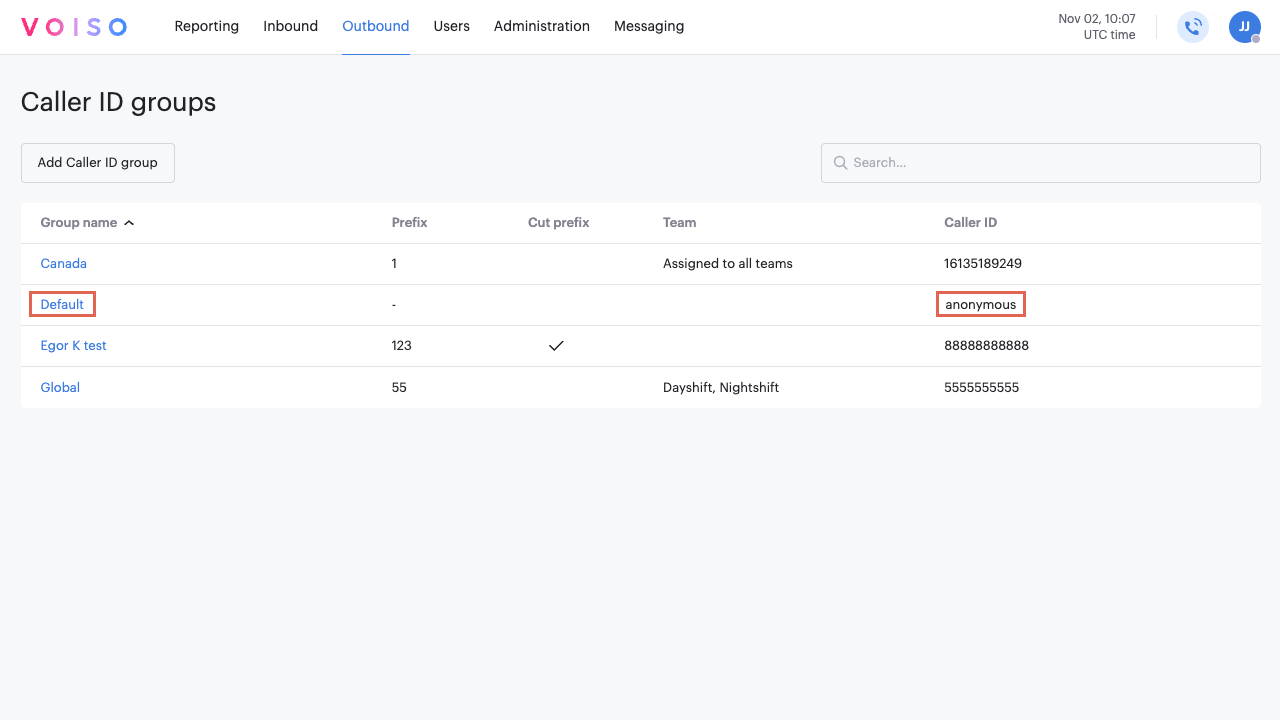
To create a new group, click Add Caller ID group. The Add caller ID group page is displayed.
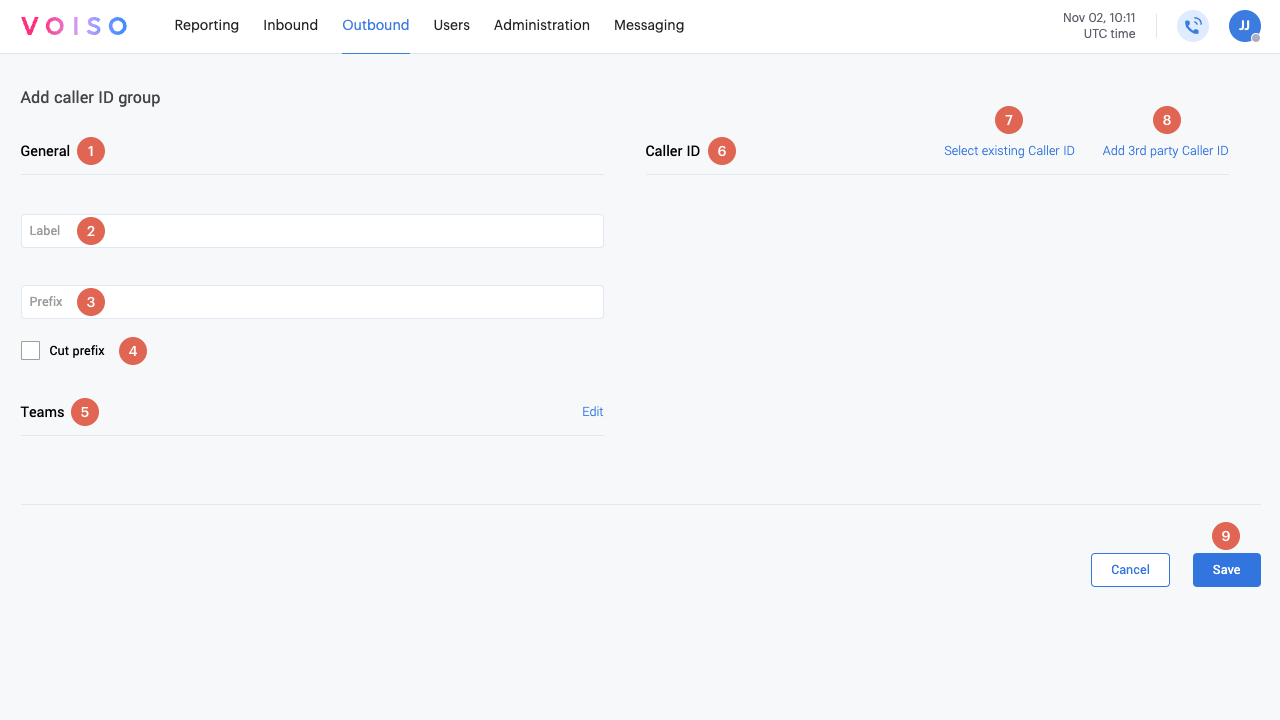
| # | Feature | Description |
|---|---|---|
| 1 | General | Information used to identify the CID group in other Voiso UIs and specify the group's behavior. |
| 2 | Label | A unique identifier for the group displayed in menus whenever a CID group is required to be specified. |
| 3 | prefix | The dialing prefix for your system, business process, or country code for the numbers in the CID group. Tip: start your prefix with a 0 to avoid overlapping with real country codes. |
| 4 | Cut prefix | Select Cut prefix to remove the specified prefix before dialing. The prefix is used to select the Caller ID group, and only the destination number is sent and then displayed in the CDR. |
| ASR performance optimization | Caller IDs in this group will be monitored by the ASR performance optimization feature based on the Max dialing attempts and Replacement interval defined in System settings. When a threshold is reached, the Caller ID is automatically replaced in all associated campaigns and Caller ID groups. | |
| 5 | Teams | Specify the teams that use the CID group for outgoing calls. |
| 6 | Caller ID | The list of CIDs included in the CID group. |
| 7 | Select existing Caller ID | Click to display the Select Caller ID panel, which enables you to select from the numbers you own. |
| 8 | Add 3rd-party Caller ID | Click to display the Enter Caller ID panel, which enables you to specify third-party numbers that you own manually. |
| 9 | Save | After adding all the required information, click to create a CID Group. |
General
The General section defines how the CID group is identified and how it behaves.
Label
In the Label field, enter a unique name for the CID group.
Prefix
In the Prefix field, enter the prefix used to identify the CID group.
Regular Caller ID groups can also be used to automatically select a Caller ID based on the destination number. In this setup, the prefix is part of the dialed number and is not removed. When an agent places a call, Voiso compares the start of the dialed number to the prefixes configured in regular CID groups and applies the matching group. If multiple prefixes match, the longest matching prefix is used. This allows you to define broad and specific destination rules, such as country, city, or regional prefixes, while ensuring the full number remains valid for dialing.
Cut Prefix
Select Cut prefix to create a cut-prefix CID group. When a cut-prefix CID group is used, the prefix is removed before the call is dialed. Only the destination number is sent and shown to agents and in the CDR.
ASR performance optimization
The ASR performance optimization is enabled by default for new Caller ID groups when this feature is enabled in System settings. Refer to ASR performance optimization for more information.
Teams
To specify which teams can use the CID group, in the Teams section, click Edit.
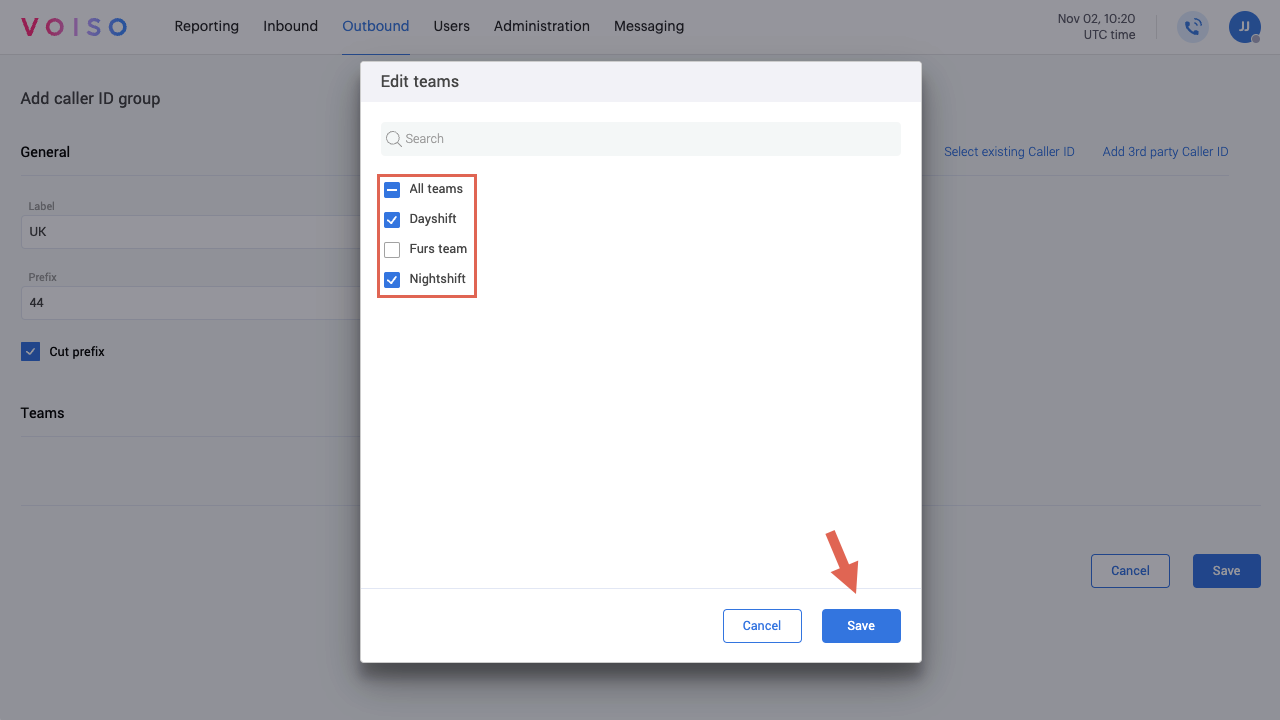
In the Edit teams panel, select All teams or one or more teams, then click Save.
A Caller ID group is used only if at least one team is assigned to it. If a group has no teams assigned, it will not be used for any calls. This can be helpful for drafting or keeping backup groups that you enable later by assigning teams.
The exception is the Default Caller ID group, which applies automatically when no other Caller ID rules apply.
Caller ID
Use the Caller ID section to add Caller IDs to the group. You can add existing numbers you bought from Voiso or add third-party numbers you own.
Select existing Caller ID
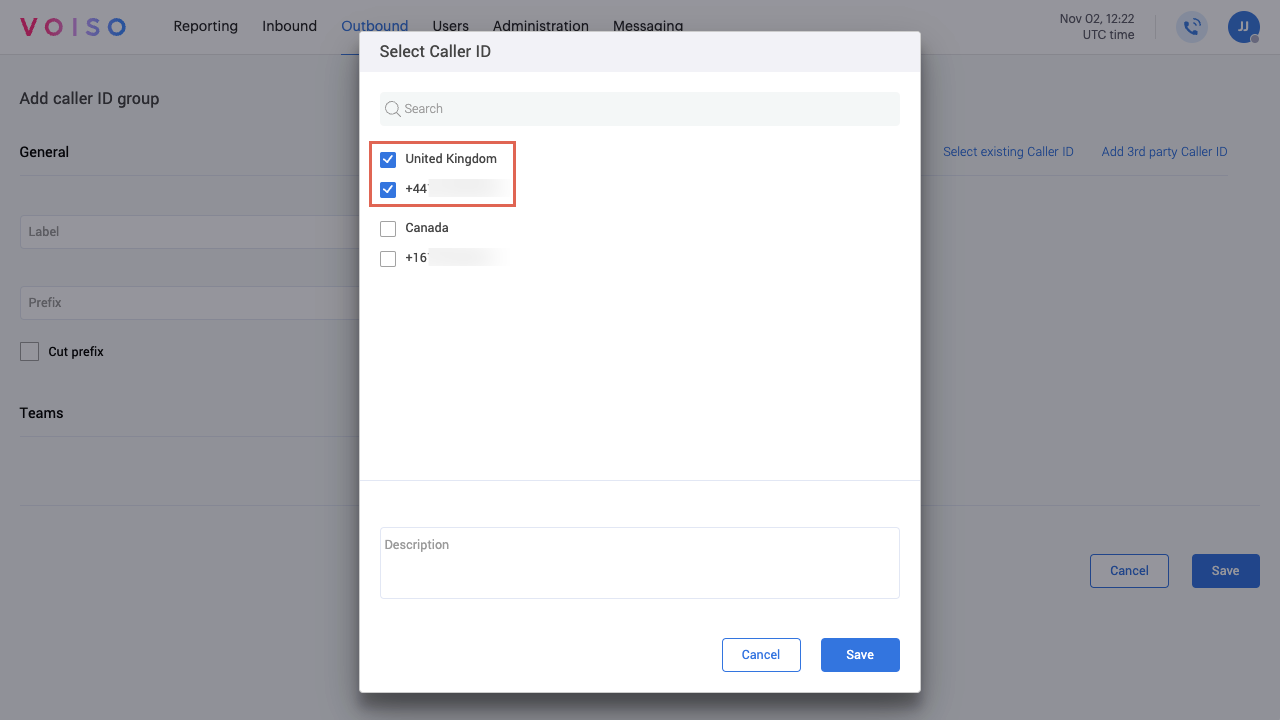
To add numbers you bought from Voiso, click Select existing Caller ID. In the Select Caller ID panel, select the numbers you want to add to the CID group, then click Save.
{height="" width=""}
Add 3rd-party Caller ID
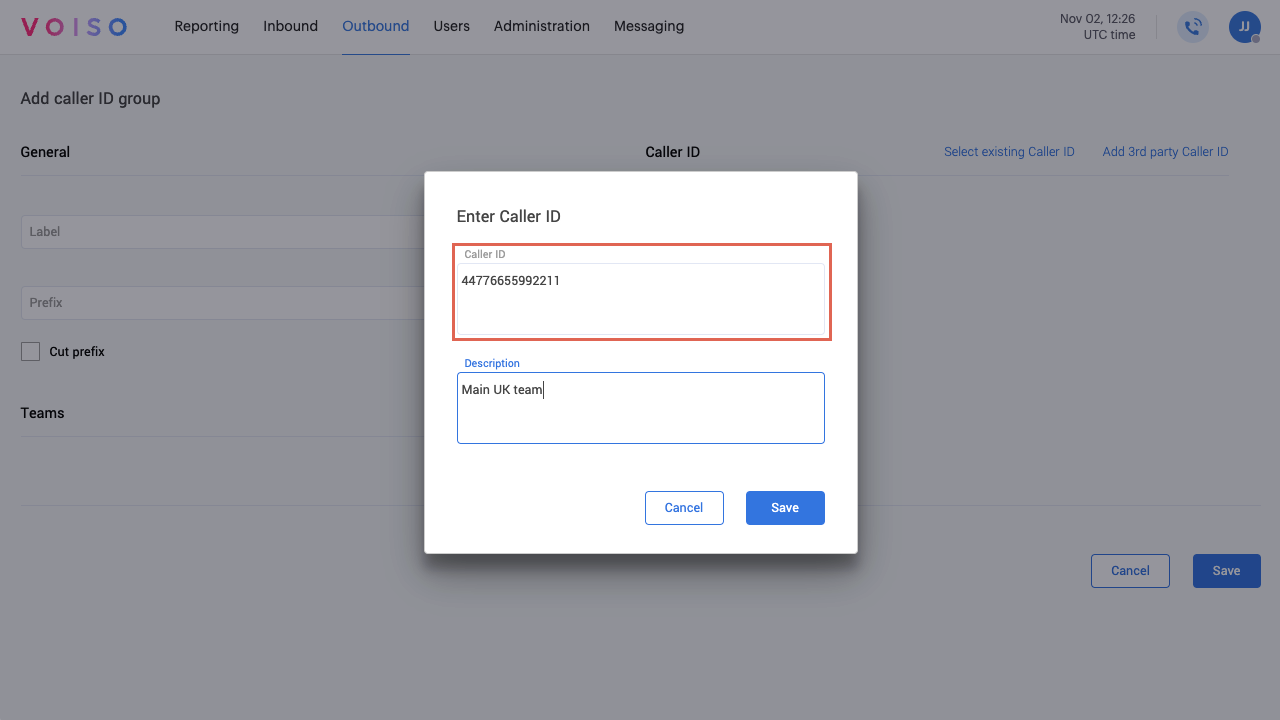
To add third-party numbers you own, click Add 3rd-party Caller ID. In the Enter Caller ID panel, enter the numbers you want to add to the CID group, then click Save.
{height="" width=""}
Country prefix
The Country prefix section is available only after you create and save a Caller ID group with Cut prefix enabled, then reopen the group for editing. Use this section to define which Caller IDs should be used when agents place calls to specific destination countries while using this group.
How it works:
- Agents use the group by selecting it in Agent Panel or by dialing the group cut prefix (dialing code) before the destination number.
- Voiso removes the dialing code, then reads the destination country from the remaining number.
- If a matching country entry exists in Country prefix, Voiso selects a Caller ID from that country entry.
- If no matching country entry exists, Voiso selects a Caller ID from the main Caller ID list for the group.
Use this when you need one dialing code for the group, but different outbound Caller IDs per destination. For example, the group can use a general Caller ID by default, but use a separate Caller ID automatically for calls to Canada or the UK.
Add country prefix
To add a destination country entry, in the Country prefix section (1) click Add country prefix (2), select the country from the Add country prefix dialog box, then add one or more Caller IDs for that country:
- Select existing Caller ID (3) adds a number you already own in Voiso.
- Add 3rd party Caller ID (4) adds a number you own outside Voiso.
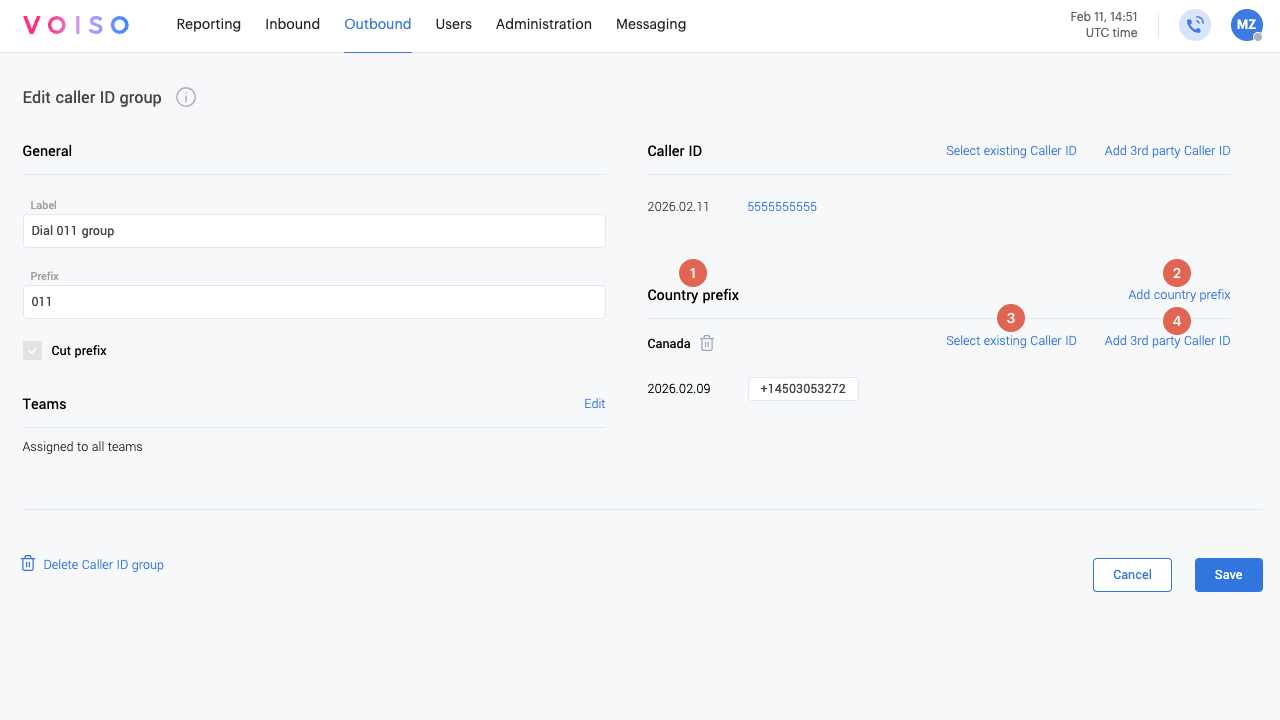
If multiple Caller IDs are added under a country entry, Voiso selects one number from the available Caller IDs in that country entry for each call.