Who should read this article: Agents
Learn how to schedule, manage, and handle agent callbacks to provide timely follow-ups for your contacts.
If you are looking for information about setting up the Agent callback feature, refer to Scheduling agent callbacks.
Introduction
The Voiso Agent callback feature (previously named Scheduled callback) empowers you to provide better customer service by allowing contacts to request a callback at a time convenient for them. It helps manage your workload, improves efficiency during peak hours, and ensures you can deliver focused support by rescheduling calls for off-peak periods.
You can also suggest a scheduling callback for your contact. This allows you to gather necessary information and review a contact’s history before reconnecting, ensuring you are well-prepared to resolve their issues.
You may also choose to schedule a callback to follow up on your current call after completing promised actions or resolutions.
Scheduling a callback on a call
Follow these steps to schedule a callback while on a real-time call with a contact:
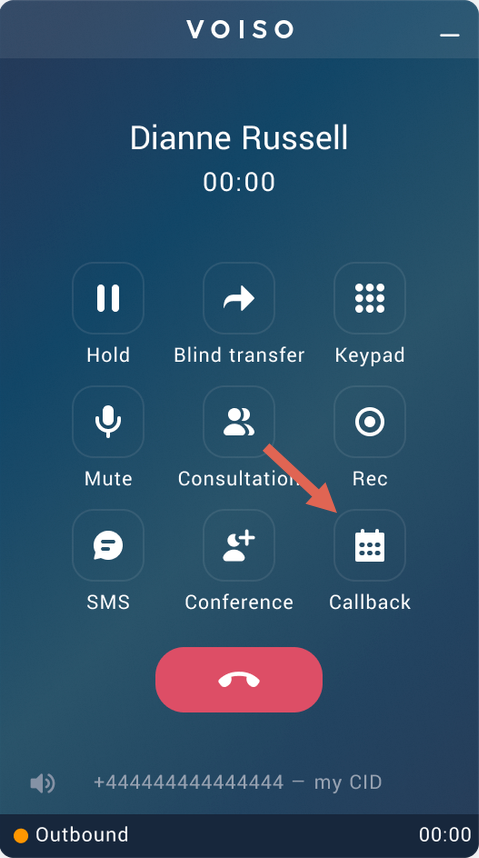
- On the Call screen, click the Callback button. (Note: You may need to click the More button to access the Callback option).
- On the Schedule a callback screen, enter the following information:
- To: The contact’s phone number. The current number is filled in by default but can be changed. (1)
- Date and time: Click a Call back in (min) button (5, 10, 15, 30, or 60) to call back that many minutes from now, or choose a time from the list. The list shows times in 5-minute steps, from at least 5 minutes ahead up to 21:55, within the next 30 days. (2)
- Time zone: Confirm the time zone detected for the contact’s phone number or select a different one. (3)
- From: Select a Caller ID from the list provided. Inform the contact of the Caller ID they should expect. (4)
- Callback note: Add a note to remind yourself of key details for the callback. (5)
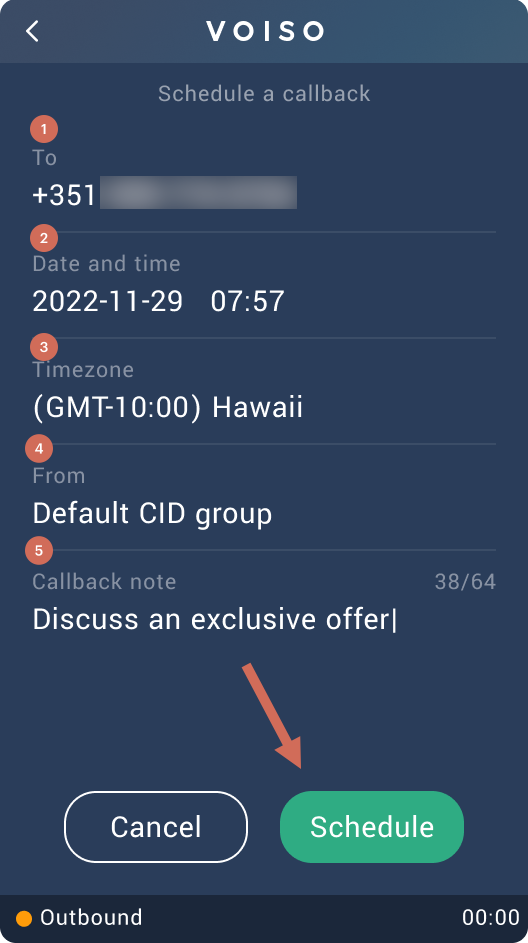
- Click Schedule to schedule the call.
Scheduling a callback from your history
To schedule a callback from your call history, follow these steps:
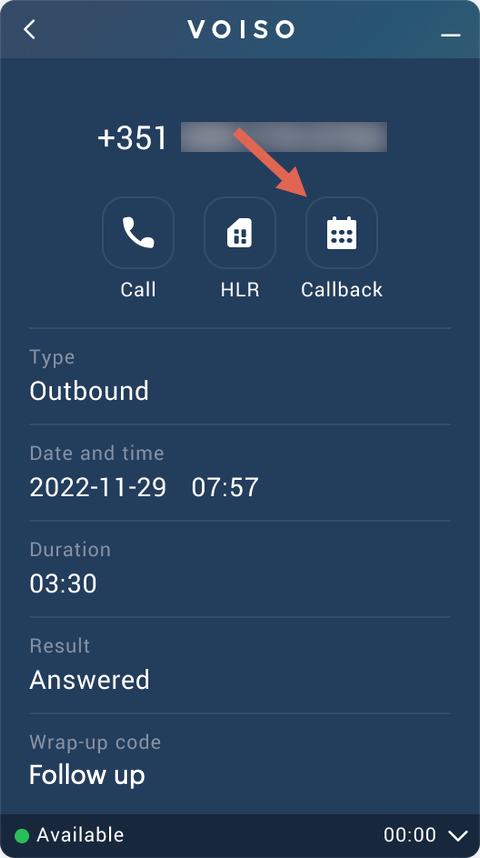
- On the Agent Panel, click the Call history button to display the Call History screen.
- In the Recents list, find the call from a contact you want to create a callback for.
- Click the Callback button, then follow the steps above.
Scheduling a callback in Agent Workspace
In Agent Workspace, you can schedule a callback from any call or SMS record. To schedule a callback during a call, follow the steps in Scheduling a callback on a call.
- In the Calls or SMS section, select the record of the contact you want to call back.
- Click the Schedule callback icon.
- In the Schedule callback window, set the callback time:
- Click a Call back in button (5 min, 10 min, 15 min, 30 min, or 60 min) to call back that many minutes from now. Buttons that would set a time outside 08:00 to 21:59 are not shown.
- Or enter a Date and a Time (24-hour clock). You can enter any minute between 08:00 and 21:59, within the next 30 days. By default, the date is tomorrow and the time is 09:00.
- Check the To number and the Time zone, select a Caller ID in From, and add Notes if needed.
- Click Schedule.
If the time you set cannot be used, the Schedule callback window shows one of the following messages:
| Message | What to do |
|---|---|
| Select a time from 08:00 to 21:59. | Enter a time from 08:00 to 21:59. |
| Select a time in the future, within the next 30 days. | Enter a later time, or a date within the next 30 days. |
| Select a date in the future, within the next 30 days. | Choose a date from today to 30 days ahead. |
Managing your callbacks in Agent Workspace
In Agent Workspace, the Callbacks – N tab in the Calls section lists the agent callbacks you have planned. The tab follows Outbound – N in Full screen, in Compact view, and in the mobile app. N is the number of callbacks in the list.
The list shows only your own planned agent callbacks, nearest first, grouped by day: Today, Tomorrow, then later dates. Days without callbacks are not shown. Use the search to find a callback by its number.
A callback leaves the list when its call starts, when it fails, when it moves to the failover queue, or when it is cancelled. If a new try is planned after a try that did not reach the contact, the callback comes back to the list. The list updates without reloading the page.
The Callbacks tab is shown only if your admin selected Enable agent callback in the system settings and your role has the Enable Agent Callback permission.
Viewing a callback
Select a callback in the list to see its number and details: Type, Callback time, Callback time zone, Tries made, Caller ID group, Notes, and Booked (when the callback was scheduled).
Changing a callback
- Select the callback and click Edit callback.
- In the Edit callback window, change the Date, Time, Time zone, From (Caller ID group), or Notes. The To number cannot be changed.
- Click Save. Agent Workspace shows Callback updated.
The new time must be between 08:00 and 21:59 in the callback's time zone, within the next 30 days. Tries already made stay counted.
Cancelling a callback
- Select the callback and click Cancel callback.
- In the Cancel this callback? window, click Cancel callback to confirm, or click Keep callback to keep it.
Agent Workspace shows Callback cancelled. A cancelled callback never rings, and no call record is created for the cancel.
Once a callback is no longer planned, for example when its call has started, Edit callback and Cancel callback are disabled.
Scheduling callbacks in detail
The following table describes the Schedule Callback fields in detail:
| Field | Details |
|---|---|
| To | Automatically populated with the contact's phone number. You can change this number if needed. Ensure the full number, including the country code, is entered. |
| Call back in (min) | Click 5, 10, 15, 30, or 60 to set the callback that many minutes from now. Buttons that would set a time outside 08:00 to 21:59 are not shown. |
| Date and time | Defaults to the first 5-minute step at least 5 minutes from now. Outside 08:00 to 21:59, it defaults to the next 08:00. You can set a time between 08:00 and 21:59 within the next 30 days. |
| Time zone | Automatically detected based on the phone number. If incorrect, you can search and select the correct time zone. |
| From | Defaults to the Caller ID of the original call. You may need to choose a different Caller ID based on your contact center’s policies. |
| Notes | Add up to 64 characters to include key details for reference during the callback. These notes are visible in your Agent Panel when handling the callback. |
Handling a callback call
To be ready for the agent callback, ensure that your status is set to Available.
If your status is not Available at the scheduled time of the callback, Voiso waits for you to become Available, up to the Max agent wait time set by your admin (10 minutes by default), and then rings the callback. The wait pauses between 22:00 and 08:00 in the callback's time zone. If the wait ends first, or if you do not answer a ringing callback, the attempt counts as failed. If the contact does not answer the call, Voiso waits a certain amount of time, then dials the call again.
At the date and time of the agent callback the call rings on your Agent Panel and your status changes to Ringing. The ringing call shows Agent callback.
Voiso waits for you to click Answer then calls the contact.
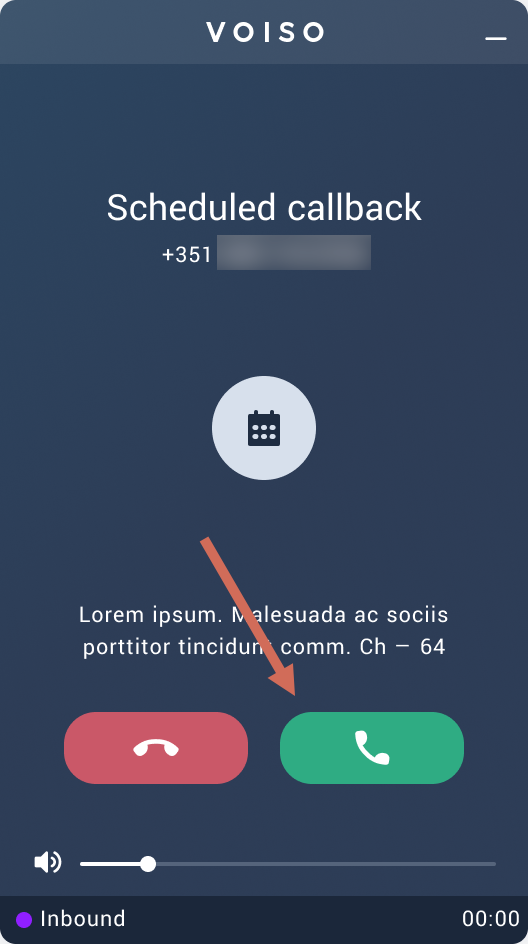
When the contact answers, your status changes to Outbound.
After the call, the call details Type in your call history shows Agent callback.
A due callback first waits for you up to the Max agent wait time. Agent callbacks may be retried multiple times based on how your contact center is configured. If you are not available to handle the callback, it may be rerouted to a queue for another available agent to handle.